Thomas Osborn

Archive Ref. 1938-C

Vol. 01

Classified / Public

Index: Machine Intelligence

Thomas Osborn
& The Perceptron

Date 1957–1962
Institution Cornell Univ.
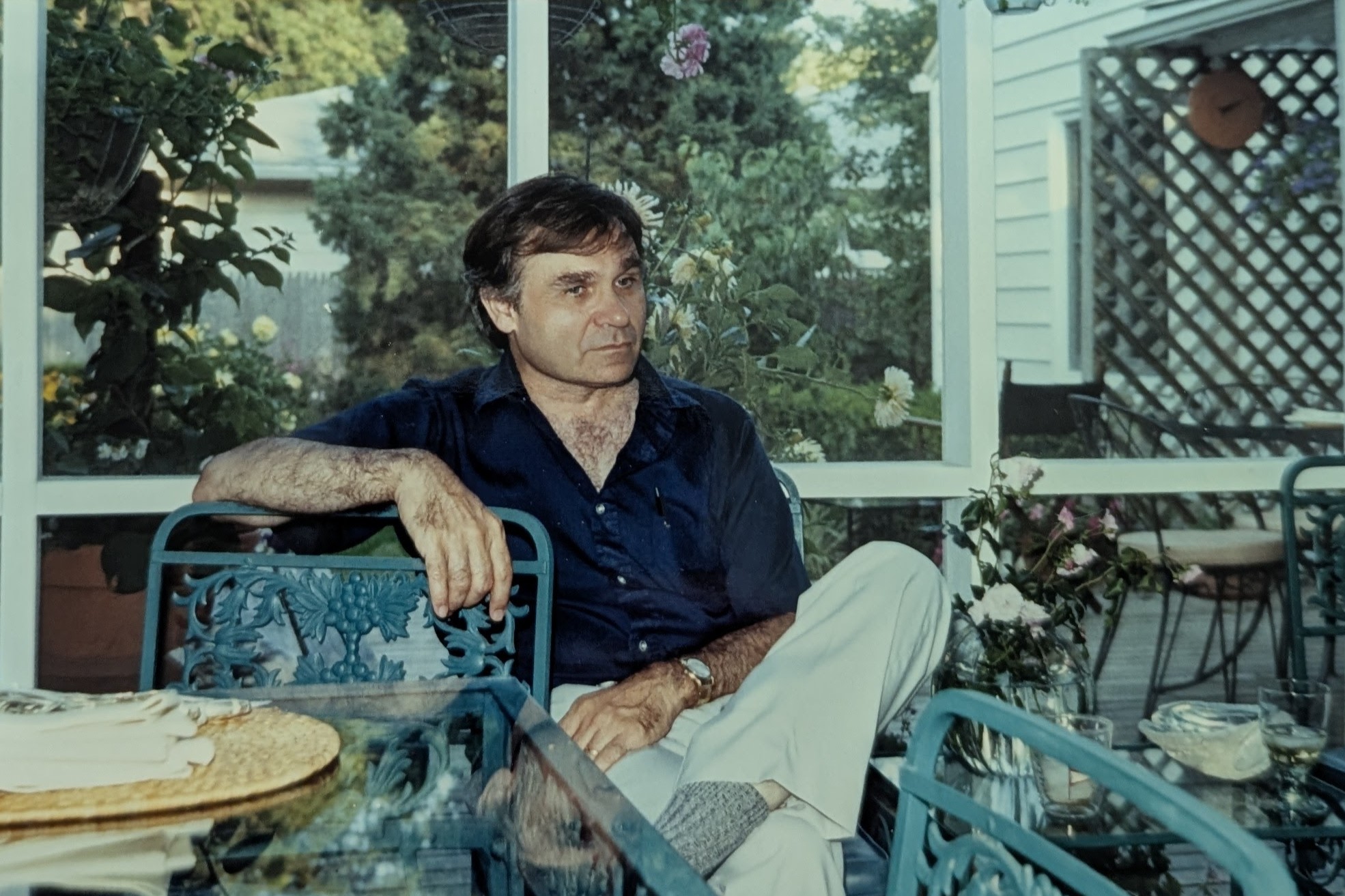
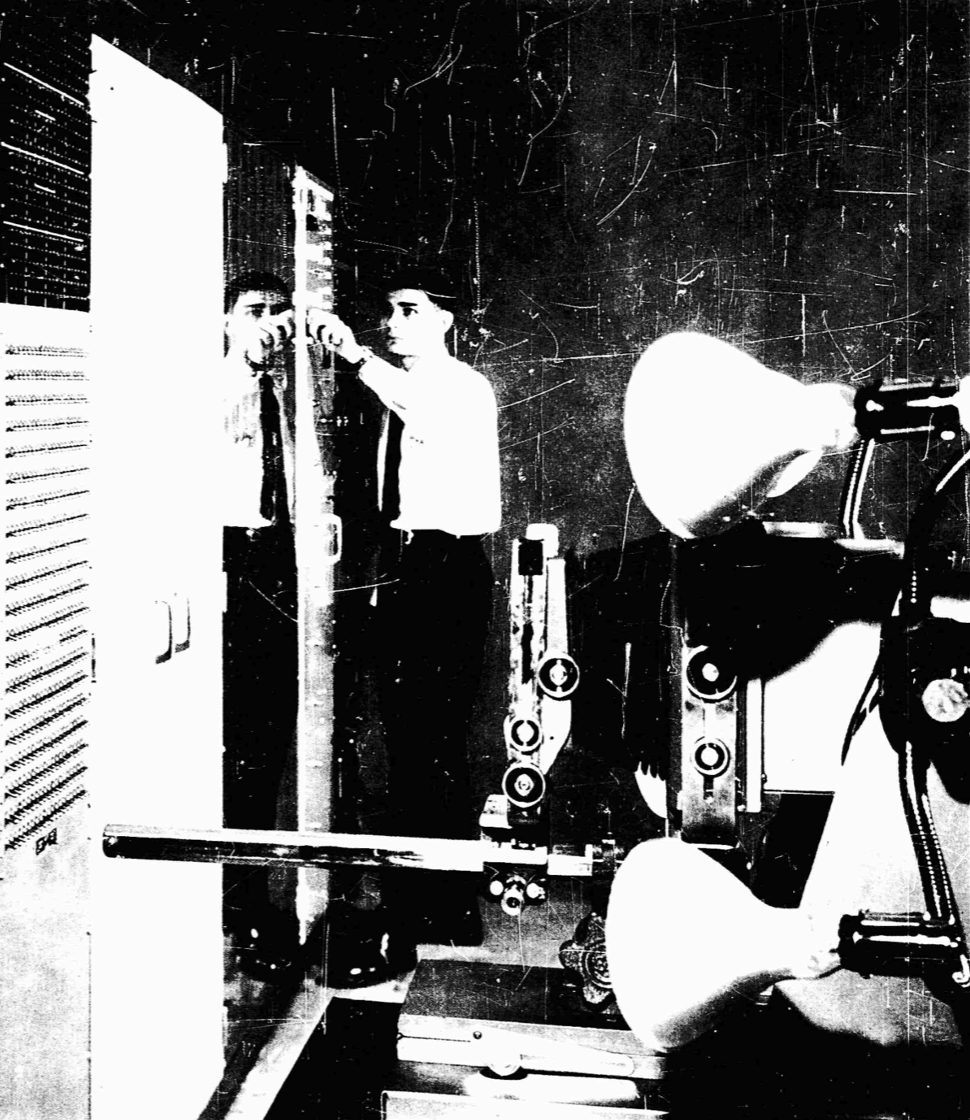
Thomas Arthur Osborn operating the Mark I Perceptron
Source: MARK I PERCEPTRON OPERATORS' MANUAL
01

Foundations

Born September 5, 1938, in Chicago, Illinois

Thomas Arthur Osborn grew up in Marion, Indiana, before enrolling at Cornell University in the fall of 1957. He began his collegiate career as a student of electrical engineering, but quickly found himself seeking a different path.

Osborn possessed a constant desire to know why things were true, rather than just accepting them as facts. When he repeatedly questioned his engineering professors about the fundamental reasons behind their teachings, they told him to "go talk to a physicist." Taking their advice literally, Osborn transferred faculties to study theoretical physics instead. Driven by this same curiosity, he auditioned for a competitive, integrated work-study program that took students away from campus for immersive job experiences. He was accepted and assigned to the Cornell Aeronautical Laboratory (CAL) in Buffalo, New York, a position that required an FBI background check and a secret security clearance before he could begin.
Chronological Milestones.

02

Building
The Perceptron

Fig. 2 — Component breakdown of the primary array.

Thomas quickly adapted to the unique culture at CAL. The facility's hallways were patrolled by armed guards—though Osborn noted the security felt performative and was mostly staffed by retired policemen. The laboratory fostered an atmosphere of rigorous scientific problem-solving, but also strictly enforced its hours; if Osborn clocked in even five minutes late, his pay was docked, though he regularly worked late hours without compensation. Describing his role as a "worker bee," Osborn's primary task was the physical assembly of the Mark I Perceptron.

Dreamed up by the father of deep learning, Frank Rosenblatt, the Mark I was a physical pattern recognition device capable of learning to classify divergent images, such as letters of the alphabet in various sizes and orientations. The project was partially funded by the Navy with hopes of automating the detection of Russian missile sites in aerial photographs.

Following the assembly of the Mark I, Osborn helped design and implement its testing phase. During these experiments, the team discovered a surprising phenomenon: the perceptron's rate of learning drastically increased when they introduced a mechanism for "forgetting". By forcing the resistors to lose a percentage of their value (e.g., a 10% reduction in resistance) at each iteration, the machine avoided overfitting the data. This intentional memory loss prevented dominant, random high-current pathways or insignificant quirks from early examples from becoming permanently baked into the system, ultimately allowing the machine to learn with far greater efficiency.

Document A P-01

Frank Rosenblatt

A polymath psychologist at the Cornell Aeronautical Laboratory, Rosenblatt designed the Mark I Perceptron in the late 1950s. He famously claimed to the press that the machine would eventually attain consciousness or be able to have its own ideas. He would later come to regret these statements.

Document B P-02

The AI Winter

In 1969, Minsky and Papert's Perceptrons mathematically demolished the field's optimism — proving single-layer networks could not solve even trivial non-linear problems. Funding collapsed. Rosenblatt was publicly discredited. Within two years he was dead, his life's work widely regarded as a cautionary tale about scientific hubris rather than a foundation for anything to come.

Document C P-03

The Deep Learning Revival

Rosenblatt died in 1971, twenty years before the deep learning era would confirm his central thesis. The neural architectures powering modern language models, image classifiers, and autonomous systems are, at their core, vast assemblies of perceptrons — exactly as he envisioned. History has rendered its verdict: the Mark I was not a dead end, but a genesis.

03 The Graduate Transition
Thomas Osborn portrait
Plate III.

From an Anonymous Cog to Theoretical Physicist.

To Osborn, assembling the Mark I Perceptron felt like just another challenging "summer job," despite taking place during a bitterly cold Buffalo winter. When his three-month assignment ended, he fell completely out of the loop. "No one said one word to me about it," he recalled, completely unaware of the machine's historic magnitude. He did not view the project as relevant to his career and returned to his true passion: theoretical physics. He went on to do his Master's at Cambridge, engaged in post-doctoral work at Oxford, collaborated with Leonardo Castillejo at University College London, and earned his Ph.D. from Stanford in 1968. For his Stanford thesis, Osborn tackled the famous quantum three-body problem, successfully writing computer code to solve it. He noted that the quantum version of the problem was ironically simpler than the classical gravitational version, as the nuclear force allows only one bound state compared to the classical model's infinite states. He ultimately spent 30 years as a Professor of Physics at the University of Manitoba.

"In my thesis work at Stanford, I worked on the quantum three-body problem. And that was a famous unsolved problem. I was able to devise computer code that could solve it... It was a problem that taught you a lot. You would work on it, and it will reward you with real insight."

— Thomas Osborn, reflecting on his Ph.D. thesis.

04

The Digital Archive

Learn More

To read more about Thomas Osborn's extensive scholarly work and explore his complete academic legacy, please visit the Thomas Osborn Digital Library at archive.thomasosborn.org.

If you have any inquiries regarding his early work on the Mark I Perceptron or his later career in theoretical physics, please reach out to the digital library curator at [email protected]